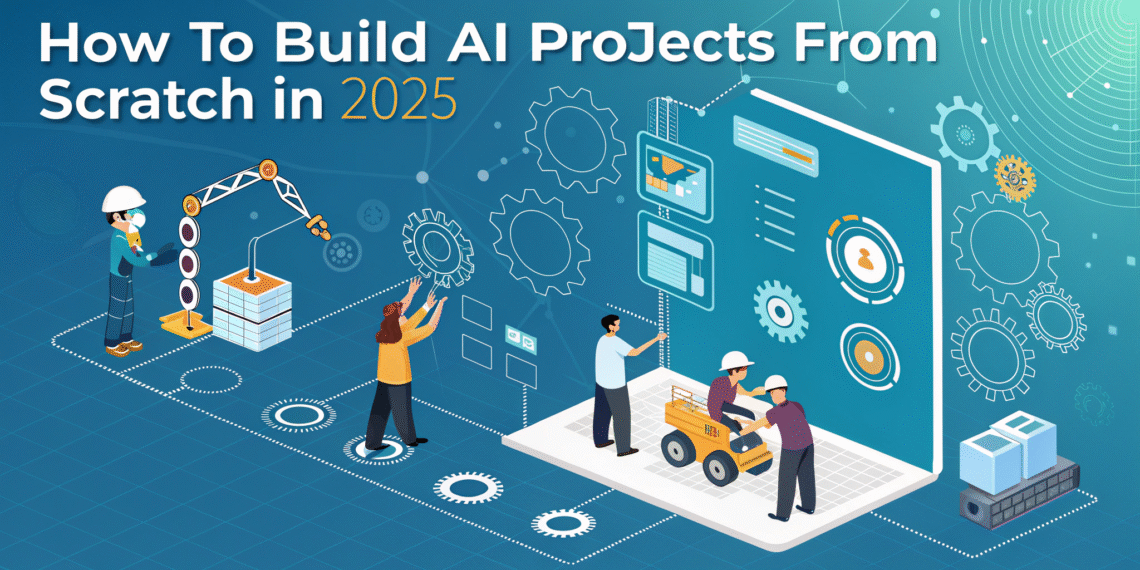

How to Build AI Projects from Scratch in 2025 25 is more accessible than ever. You no longer need to be a programming expert or a data scientist. With modern tools, pre-trained models, and easy-to-use platforms, anyone can start building AI projects from scratch, even as a beginner. This guide will help you understand the process, choose the right tools, and get started with practical projects that are relevant in today’s AI-driven world.
Step 1: Identify a Clear Problem
Every AI project starts with a clear and specific problem. Without a focused goal, even the most advanced AI tools won’t be effective. Choose a problem that can benefit from automation, prediction, or intelligent analysis. Examples include predicting sales, classifying images, generating content, or creating a chatbot. A well-defined problem will guide your choice of tools and approach.
Step 2: Choose the Right AI Approach
Depending on the problem, you’ll need to select the appropriate AI method. Common approaches include:
- Machine Learning for predictions and data analysis
- Natural Language Processing (NLP) for text-based tasks like chatbots and sentiment analysis
- Computer Vision for image and video recognition
- Reinforcement Learning for decision-making systems
Matching the right AI approach to your problem is critical for success.
Step 3: Gather and Prepare Data
Data is the foundation of any AI project. Collect relevant datasets from public sources, APIs, or company records. Make sure the data is clean, structured, and representative of the problem you want to solve. Data preparation involves removing duplicates, handling missing values, and transforming data into a format suitable for modeling. The better your data, the better your AI will perform.
Step 4: Select Tools and Platforms
In 2025, AI development doesn’t always require coding from scratch. Useful tools include:
- Python with libraries like Scikit-learn, TensorFlow, or PyTorch for ML and deep learning
- Hugging Face for pre-trained models and NLP projects
- OpenAI or Gemini APIs for language-based AI tasks
- LangChain for creating AI workflows
- No-code platforms like Peltarion or Teachable Machine for beginners
For beginners, starting with pre-trained models or APIs is often the fastest way to see results.
Step 5: Build and Train Your Model
Depending on your chosen approach, you may train a model from scratch or fine-tune an existing one. Beginners can start by using pre-trained models, adjusting them for specific tasks. For example, you can fine-tune a language model for customer support queries or train a simple image classifier using transfer learning techniques.
Step 6: Test and Evaluate
Evaluation is crucial to understand your AI’s performance. Common metrics include accuracy, precision, recall, and F1-score. Testing with real-world scenarios helps identify weaknesses and areas for improvement. Iterative testing and feedback ensure your model performs reliably and ethically.
Step 7: Deploy and Integrate
Once your AI project is working effectively, deployment is the next step. Popular deployment options include:
- Web apps using Streamlit or Gradio
- APIs with Flask or FastAPI
- Cloud platforms like AWS, GCP, or Azure
Deployment makes your AI accessible to end-users and allows it to provide real value in real-world applications.
Beginner-Friendly Project Ideas
- AI Chatbot: Automates customer service using LLM APIs
- Image Classifier: Detects objects, plants, or products using computer vision
- Recommendation System: Suggests products, books, or courses based on user preferences
- Predictive Analytics: Forecasts sales, trends, or user behavior
- Content Generator: Creates blog posts, marketing content, or social media posts
Final Thoughts
Learning how to build AI projects from scratch in 2025 requires curiosity, practice, and the right approach. Start small, focus on solving meaningful problems, and gradually explore more complex AI techniques. With persistence, you can build a strong AI portfolio and gain practical skills that are in high demand.
By following this guide, beginners can confidently start creating AI projects without being overwhelmed by coding or mathematics, taking full advantage of the 2025 AI ecosystem.